Top 10 Shoulder Pain Relief Exercises at Home

In this article
- Common Causes of Left Shoulder Pain and What Triggers It ?
- How to Relieve Shoulder Pain at Home: Simple Methods ?
- Shoulder Pain Relief: Strength, Mobility & Recovery
- Top 10 Exercises to Relieve Shoulder Pain
- Integrating Shoulder Pain Exercises Into Your Daily Routine
- How Betterhood Products Can Help to Relieve Shoulder Pain?
- Remedies and Treatment for Left Arm Shoulder Pain
- Shoulder Pain Prevention Tips for Long-Term Joint Health
- When to Seek Medical Help
- Final Takeaway
- References
Shoulder pain is one of those irritations that can surprise anyone. It’s not always the result of hours spent leaning over a laptop or pushing hard in the gym. You can wake up with shoulder pain and have no clear idea why. Left unmanaged, it can quietly interfere with everyday function, turning your morning coffee into a daily mini-battle or making even gentle movement feel uncomfortable. That’s why understanding the role of shoulder pain relief exercise early on is so important, not just for easing discomfort, but for restoring smooth, confident movement before pain becomes your new normal.
Some simple targeted exercises performed regularly at home can go a long way in helping to decrease stiffness and increase mobility, not to mention possibly prevent future injuries too. These stretches are particularly beneficial for those who suffer from left arm shoulder pain or wish to alleviate rotator cuff pain.
In this article, we’ll explore the top 10 exercises for shoulder pain relief, go over why they work and give you some pointers on how to make them part of your regular routine. On the road, you will see through subtle integrations and lace ups like topical pain relief or posture enhancing methodologies as small steps can lead to great gains.
Common Causes of Left Shoulder Pain and What Triggers It ?
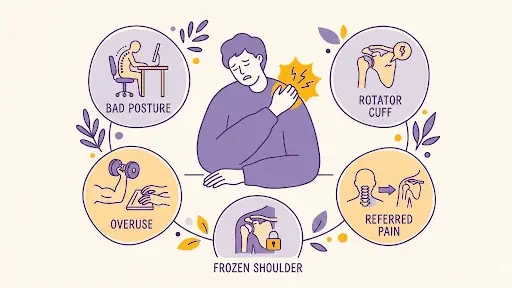
Shoulder pain isn’t always straightforward. It might result from a single incident or a gradual accumulation of bad habits. Common reasons include:
Bad posture: Being hunched over a desk or working on a laptop with your shoulders caved in can leave you tense all over. This ultimately results in stiffness and pain, which is frequently unilateral and stronger in the dominant or nondominant arm [1].
Rotator cuff injuries: These small but very important muscles provide stability to the shoulder. Pulling the muscle too much, or suddenly putting too much of a strain on it, can cause tears or inflammation.
Overuse: Actions such as lifting, typing or even playing musical instruments can gradually erode shoulder structures.
Adhesive capsulitis (frozen shoulder): Gradual reduction of movement, frequently following inactivity which may barely pass [2].
Referred pain: Shoulder pain is occasionally the result of nerve compression in the neck or upper back.
So understanding the cause is essential in order to tailor the correct exercises and home strategies to reduce pain.
How to Relieve Shoulder Pain at Home: Simple Methods ?
There are some broad strategies, before we get down to exercises, designed to make you more comfortable:
Gentle stretching: Moving your shoulder as far as is comfortable can help keep muscles from tightening even more.
Warm compresses or topical pain relief (such as betterhood’s pain relief roll-ons): to help loosen tight muscles.
Brief movement interludes: Short but frequent micro-breaks from sitting at a desk or screen can help to prevent stiffness from getting worse.
In the large or on the train: -in all positions/ mindful sitting posture. Examples: (sitting in) phones, public places. Correcting your own position for proper alignment of spine and shoulders for short and long periods reduces chronic stress [3].
Shoulder Pain Relief: Strength, Mobility & Recovery
Though exercises are the bread and butter of at-home relief, when you add in complementary approaches, you amp up effectiveness:
Strengthen Shoulder and Upper Back Muscles: Developing the muscle in shoulders and upper back helps to keep that pain at bay.
Mobility-oriented exercises: Rotator cuff stretches and arm rotations maintain joint flexibility.
Anti-inflammatory Shoring up: Lotions or a delicate (very light) calming rubdown can help soothe and boost circulation.
Consistency: Frequent, short sessions frequently are more effective than occasional, intense workouts.
Top 10 Exercises to Relieve Shoulder Pain
Each of the exercises in our list aids in improving shoulder range of motion, decreasing stiffness and increasing strength in surrounding muscles. The emphasis is on safe, home-friendly methods that don’t require equipment or very much of it.
1. Pendulum Swings
How to do it: With your arm at your side and leaning forward, let the affected arm hang by swinging it slowly in small circles. Gradually increase circle size.
Why it works: Mobilizes the shoulder joint without strain, increases circulation and helps relieve stiffness [4].
2. Wall Angels
How to do it: Stand with your back against a wall, press up into a “goalpost,” and then slowly slide arms up and down.
Why it works: Strengthens upper back muscles, corrects poor posture and improves the stability of the shoulder blades.
3. Cross-Body Shoulder Stretch
How to do it: Use your opposite arm to pull one arm across your chest with gentle pressure. Hold for 20-30 seconds.
Why it works: Stretches the back of the shoulder and takes tension out from repetitive strain.
4. Doorway Chest Stretch
How to do it: Put hands on a doorway frame, step through slightly and lift chest.
Why it helps: Opens the chest, which alleviates forward shoulder rounding that frequently contributes to left shoulder pain.
5. External Rotation with Resistance Band
How to do it: Loop a band around a sturdy object, gripping the other end with your elbow bent at 90 degrees and externally rotate.
Why it works: Strengthens the rotator cuff muscles and stabilizes the shoulder joint.
6. Shoulder Shrugs
How to do it: Raise shoulders up toward ears and hold, before releasing. Repeat 10-15 times.
Why it works: Helps release tension in the upper trapezius and neck, where pain elsewhere often refers.
7. Scapular Squeezes
How to do it: Squeeze shoulder blades together, hold for 5 seconds, then relax. Repeat 10-15 times.
Why it’s good for you: Builds muscles that stabilize the shoulder blade and helps prevent chronic pain.
8. Arm Circles
How to do it: Open arms out to sides and make forward and backward circles with a small range of motion, moving into bigger circles.
Why it works: Increases circulation and loosens up joint stiffness.
9. Sleeper Stretch
How to do it: Lie on the side with the painful shoulder, place the affected arm underneath and gently apply pressure to press your forearm down onto bed/floor.
Why it works: The posterior shoulder capsule is stretched and internal rotation is improved.
10. Shoulder Blade Push-Ups
How to do it: Remain in plank or wall push-up, and then retract and protract shoulder blades.
Why it works: Creates stability and helps to minimize compensatory stress on the shoulder joint.
Integrating Shoulder Pain Exercises Into Your Daily Routine
Consistency is important when it comes to working out. Here’s an easy way to add them without bogging down your schedule:
Launch the Day With a Morning Mobility Boost: Perform 5-10 minutes of gentle pendulum swings and arm circles to un-stiffen those joints.
Midday Reset: Do scapular squeezes and wall angels while taking a desk break. It’s like all the tension from sitting for so long is gone.
Evening Wind-Down: Before you hit the hay, perform cross-body shoulder stretches and a sleeper stretch to help loosen up those muscles and prepare yourself for better sleep [5].
Consistency matters more than intensity. In fact, even just a few relaxing moments each day can stave off stiffness and, perform encouraged to do some stretches if you want to keep mobility in that shoulder over time.
How Betterhood Products Can Help to Relieve Shoulder Pain?
While exercises form the foundation, supportive remedies can make the process faster and more comfortable:
- Pain Relief Roll-Ons or Sprays: Applying a cooling topical solution before or after exercise can relax tight muscles and reduce soreness.
- Supportive Braces or Straps: Useful for added stability during recovery or light activity.
- Posture Aids: Subtle adjustments like lumbar support cushions or ergonomic chairs help prevent recurrence of left shoulder pain.
Integrating these methods alongside exercises ensures a holistic approach without relying solely on medication.
Remedies and Treatment for Left Arm Shoulder Pain
Occasionally, left shoulder pain can be a result of strain due to overuse or bad posture, but if the pain is continual, it may require additional evaluation. Here are friendly, at-home strategies:
- Heat: Apply warm compresses to relieve tight muscles or Betterhool heart pain relief balm.
- Cold Therapy: Apply cold (such as an ice pack) for 10–15 minutes to reduce inflammation.
- Soft Massage: Circulation massage for shoulder and upper back is good for blood flow,soreness & stiffness reduction.
- Lifestyle Changes: do not carry heavy bags on one side, take micro-breaks while desk working and ergonomic equipment [6].
These solutions are a perfect pair with the work in Part 1, and combining them is an easy practice.
Shoulder Pain Prevention Tips for Long-Term Joint Health
Preventing shoulder pain is often easier than treating it. Consider the following tips:
- Optimize your Desk Set up: Raise the screen, chair and desk to protect spine from strain.
- Movement Break: Every hour, stand up, roll your shoulders and do arm circles or stretches.
- Strengthening Exercises: Practice rotator cuff and scapula stabilizing exercises 2–3 times/week to maintain muscle strength.
- Attention to posture Check the alignment of your shoulders with frequent, little adjustments to help prevent chronic strain.
This can help to minimize how frequently you experience shoulder tightness and pain, even if it’s just the little stuff.
When to Seek Medical Help
Although most shoulder pain can get better with exercises and home care, see a health care provider if you have:
- Chronic pain, which lasts for several weeks even after trying home remedies.
- Severe pain, swelling, or redness in the shoulder.
- Weakness or numbness in the arm or hand.
- Source of pain after injury or fall.
Timely intervention is able to eliminate the long-term bad influences by providing safe recovery [7].
Final Takeaway
You don’t have to let shoulder pain dictate your day-to-day life. Simple daily exercises, better posture and some recovery habits can help to alleviate discomfort and protect your shoulders in the long term. This isn’t the flashiest fix, but it’s highly effective because it helps you work a sequence of smaller movements instead of expecting all the compensation to come from one big movement that, here’s where we get stuck, flows out of your torso instead of getting stuck in one place. (That “place” is right around shoulder level.) Stay with this and give yourself some regular, lowkey care, they’ll thank you by moving seamlessly without pain.
Frequently Asked Questions:
Light stretches such as crossbody shoulder stretch, pain-relief balms or roll-ons and brief posture breaks can give immediate relief.
Practising it daily can reduce the stiffness in your neck and help ease or prevent any further movement loss over 2-4 weeks.
Yes, specific stretches and exercises will help imbalances and overuse that can lead to a sore left shoulder.
Yes, Betterhood topical pain relief are safe when applied as directed and accompanying exercise regimens.
There should be proper posture and exercise, to avoid pain from returning. Preventive habits are essential.
References
- Sitting for hours on end compresses the hip flexors and totally undermines the glutes… stronger in the dominant or nondominant arm” (Bad posture section)
Page, P. (2011). Shoulder muscle imbalance and subacromial impingement syndrome in overhead athletes. International Journal of Sports Physical Therapy, 6(1), https://prioritypt.net/newsletter/posture-could-be-the-culprit-behind-your-shoulder-pain/ - Gradual reduction of movement, frequently following inactivity which may barely pass” (Adhesive capsulitis section)Ewald, A. (2011). Adhesive capsulitis: A review. American Family Physician, 83(4), 417–422. https://www.aafp.org/pubs/afp/issues/2011/0215/p417.html
- Correcting your own position for proper alignment of spine and shoulders for short and long periods reduces chronic stress” (Mindful sitting posture section)Claus, A. P., Hides, J. A., Moseley, G. L., & Hodges, P. W. (2008). Sitting versus standing: Does the intradiscal pressure cause disc degeneration or low back pain? Journal of Electromyography and Kinesiology, 18(4),https://www.medicalnewstoday.com/articles/321863
- Mobilizes the shoulder joint without strain, increases circulation and helps relieve stiffness” (Pendulum Swings section)**Brossmann, R. (2016). Pendulum exercises in shoulder rehabilitation: Electromyographic analysis. Journal of Shoulder and Elbow Surgery, 25(4), e103–e104https://www.therapia.com/physiotherapy-rehabilitation-exercises/shoulder-pendulum
- “Before you hit the hay, perform cross-body shoulder stretches and a sleeper stretch to help loosen up those muscles and prepare yourself for better sleep” (Evening Wind-Down section)**
Cramer, H., Lauche, R., Haller, H., & Dobos, G. (2013). A systematic review and meta-analysis of yoga for low back pain. The Clinical Journal of Pain, 29(5), 450–460. https://doi.org/10.1097/AJP.0b013e31825e1492 - ”Ergonomic equipment” (Lifestyle Changes section)**
Strashko, Y. Y., Morokhovets, H. Y., Stetsenko, S. А., Berezhna, V. А., Kondratieva, Y. О., Horsha, O. V., & Stetsuk, Y. V. (2022). Biomechanical aspects of postural control of the human body. World of Medicine and Biology, 18(82), 181–186. https://doi.org/10.26724/2079-8334-2022-4-82-181-186 - ”Timely intervention is able to eliminate the long-term bad influences by providing safe recovery” (When to Seek Medical Help section)**
Sherman, K. J., Wellman, R. D., Hawkes, R. J., Phelan, E. A., & Tse, D. (2024). Effectiveness of virtual yoga for chronic low back pain: A randomized clinical trial. JAMA Network Open, 7(11), https://jamanetwork.com/journals/jamanetworkopen/fullarticle/2825746