The Neuroscience of Acupressure for Stress Relief
In this article
- Why Does Stress Affect Our Body So Much?
- How Does Acupressure Help Reduce Stress ?
- Which Acupressure Points Help Calm the Mind and Body?
- How to use these points:
- The Brain–Body Loop: How Pressure Changes Brain Signals
- How Does Applying Pressure Affect the Nervous System?
- Key Acupressure Points for Anxiety and Stress Relief
- Supporting Acupressure with the Right Daily Tools
- Can Acupressure Be Used Anywhere and Anytime?
- Is Acupressure Right for You? Safety Risks to Consider
- How to Build a Daily Stress-Relief Routine ?
- Conclusion:
- References
Stress. We are all subjected to this plague, in different ways. It sometimes sneaks in quietly as a subtle tightness of the muscles, shallow breathing, a racing mind, and other times it hits with a headache, stiff shoulders, and sleepless nights. It is more than just an emotion; it is the nervous system sending a signal to the brain that it is beyond its capacity. However, what if you could simply turn your body and mind’s ‘reset’ button by just using your fingers and that too at your home?
So, it sounds as if it’s magic, doesn’t it? Actually it is the acupressure tradition’s magic.
Acupressure helps here by soothing the stressed nervous system with the help of the body points connected to the same system. Thereby it calms down the stress response and balance gets restored.
In this article, we explain the interaction between acupressure and the body’s stress pathways, point out the most important pressure points that can relieve tension instantly, and help you with a simple daily routine. With a few minutes of concentrated pressure, you can stabilize your emotions, relax the muscles and invite calmness into your life in a completely natural and safe way.
Why Does Stress Affect Our Body So Much?
Stress is more than a mental state – it is a physiological reaction of the whole body. In situations of stress, the body releases hormones such as cortisol and adrenaline. These hormones set the ‘fight or flight’ mode in motion: the heart rate is increased, muscles tightened, breathing made shallow, and alertness is intensified.
This reaction can be of great use in a short time, because it enables quick responses. However, if stress is sustained, the consequence is chronic stress, which may lead to long working hours, constant deadlines, lack of sleep, emotional pressure, and the same physiological response that becomes detrimental.[1]
- Muscles continue to be tensed (hello, neck and shoulder stiffness).
- Blood pressure and heart rate stay elevated.
- Sleep quality deteriorates.
- Diseases of the digestive system and the immune system result from stress.
- What happens is that over time, you become fatigued, anxious, and frequent headaches as well as aches may affect you.
The continual mode of ‘being on alert’ consumes your energy and has a negative impact on your health in the long run.
This is why it is crucial to manage stress not only once in a while but through small daily habits. And the simplest, most affordable, and most accessible habits are sometimes the best ones: such as acupressure.
How Does Acupressure Help Reduce Stress ?
At a glance, acupressure may look like something belonging to ancient stories. However, contemporary research gives an explanation rooted in human physiology.
1. Stimulating nerve endings & reducing tension
When certain points are pressed, nerve endings stimulating the point are activated and they send a signal to the brain saying, “Relax, we are safe.” This, in fact, quite eminently alleviates the intensity of the pain or stress already sensed by the brain. Thus, the ending of habitual tension is achieved.[2]
2. Boosting circulation & oxygen flow
Soft treatment here and there on the body improves blood circulation to areas of muscles that are tight or tense due to the lack of oxygen and nutrients. At the same time, this process helps remove metabolic waste that may be the source of muscle stiffness and ‘stress buildup’.[3]
3. Shifting your nervous system balance
There is an increasing number of research works that point at the binding of acupressure with the parasympathetic nervous system- the ‘rest and digest’ side which reverses the effect of the stress-driven sympathetic response. As a result, this can cause the lowering of heart rate, alleviation of blood pressure, and the sensation of calmness.
Moreover, the measurable lowering of the heart rate and anxiety levels has been observed during brief acupressure sessions at selected points.[4]
4. Triggering the release of “feel-good” biochemicals
Contact, pressure, and light massage are the factors that lead to the liberation of endorphins and other calming neurochemicals which in turn help the brain to ‘dim the light’ of stress and anxiety.
In everyday terms, acupressure is not magical; rather, it assists the body in recalling the way to relaxation. Mere 5-10 minutes daily can change the nervous system’s mode from ‘fight or flight’ to ‘rest and rejuvenate’.[5]
Which Acupressure Points Help Calm the Mind and Body?
These are 7 strong points that both research and traditional wisdom emphasize for relieving stress and general mind-body well-being.
| Point | Location & How to Find | What It Helps With / Why Use It |
| LI4 (Hegu) | Between thumb and index finger: squeeze gently | Reduces general tension and anxiety; calms the mind during stress bursts |
| Yintang (“Third Eye”) | Centre of forehead, just above the space between eyebrows | Helps quiet racing thoughts; ideal for pre-sleep or overthinking |
| PC6 (Neiguan) | Inner wrist- about two finger-widths above the wrist crease | Eases nausea, palpitations, fight-or-flight nervousness; good for sudden stress |
GV20 (Baihui) | Top of head (center): when you draw a vertical line from the middle of the forehead to the crown | Promotes mental clarity, reduces mental fatigue, induces calm |
ST36 (Zusanli) | Lower leg- about four finger-widths below the kneecap, slightly outside the shinbone | Boosts overall energy, supports resilience, helps regulate digestion and stress recovery |
BL10 (Celestial Pillar) | Base of skull, where neck meets head feel soft hollows on either side | Relieves neck, shoulder tension; reduces headaches related to stress |
SP6 (Sanyinjiao) | Inner leg- about three finger-widths above ankle bone, close to the shin | Helps hormonal balance, calms the nervous system; especially useful in PMS or stress-induced mood swings |
How to use these points:
- Take a thumb or an index finger. Firmly but comfortably, without causing pain, apply the pressure.
- For each point, pressing or gentle massaging should be done for around 30-60 seconds.
- While pressing, breathe deeply, slowly take the air in and let it out fully.
- Additionally, 4-5 points can be used in a sequence for a rapid stress-relief session lasting 5-10 minutes (for example, LI4 → Yintang → PC6 → GV20 → ST36).
Such a brief practice helps your body to receive the ‘turn off’ stress signal and the change to relaxation mode.
The Brain–Body Loop: How Pressure Changes Brain Signals
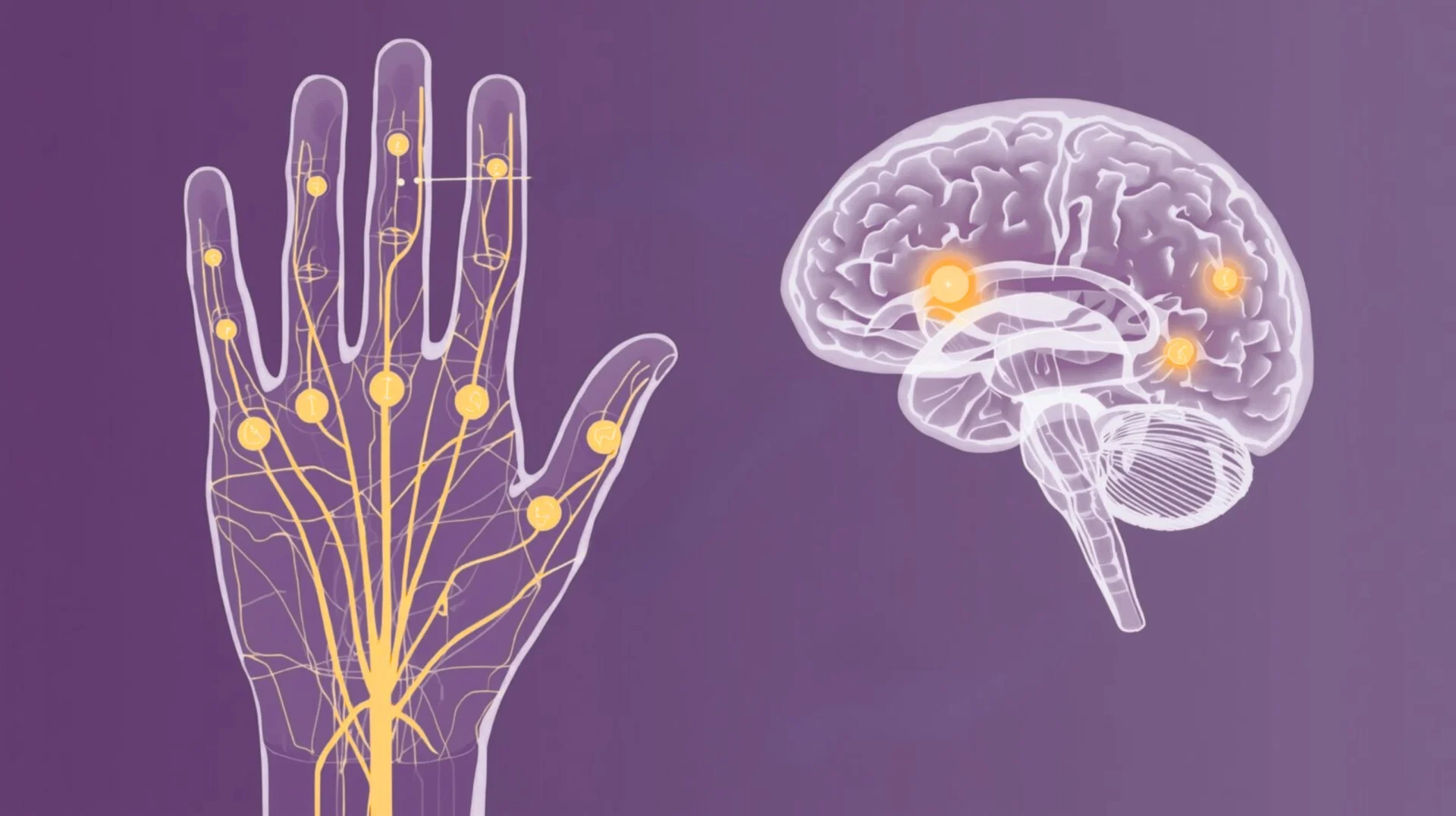
Acupressure works through a feedback loop between the body and brain.
When pressure is applied:
- Sensory nerves send signals to the brainstem
- Stress signaling decreases
- Vagal tone improves
- Cortisol production drops
The brain then responds by reducing muscle tension and slowing breath. This loop teaches the nervous system that calm is safe and accessible.
Stress Response vs Relaxation Response
| Stress Response | Relaxation Response |
| High cortisol | Reduced cortisol |
| Rapid heartbeat | Slower, steady heart rate |
| Shallow breathing | Deep, diaphragmatic breathing |
| Muscle tension | Muscle relaxation |
| Hypervigilance | Mental clarity & calm |
How Does Applying Pressure Affect the Nervous System?
In order to know the reasons why acupressure is effective, we need to understand the brain and nervous system reactions.
Softness on acupoints leads to the activation of nerve endings that have effect on the autonomic nervous system. This will limit the release of stress hormones like cortisol, thus, the body will be assisted in calming down.
Also, the vagus nerve, one of the major nerves that functions as the body’s “brake pedal”, may be stimulated. With stimulation, functions such as slowing of the heart rate, reduction of blood pressure, and promotion of calm, restful states takes place.
This change from the “fight-or-flight” to “rest-and-digest” mode gives the mind and body time to recover: muscles relax, breathing slows down, and brain activity shifts from being in a state of hyper vigilance thus space is made for calmness, clarity, and better sleep.
This is the reason why acupressure has a positive impact not only on muscles or pain but also on the way the body feels and behaves internally. Consistent practice strengthens the nervous system’s ability to choose calm as a default state rather than tension.[6]
Key Acupressure Points for Anxiety and Stress Relief
Below are evidence-supported acupressure points for anxiety and stress.
| Point | Location | Benefits |
| LI4 (Hegu) | Between thumb & index finger | Relieves tension, anxiety |
| Yintang | Center of forehead | Calms racing thoughts |
| PC6 (Neiguan) | Inner wrist, 2 finger-widths up | Reduces panic & palpitations |
| GV20 (Baihui) | Top center of head | Mental clarity, calm |
| ST36 (Zusanli) | Below kneecap, outer shin | Energy, stress resilience |
| BL10 | Base of skull | Neck tension, headaches |
| SP6 (Sanyinjiao) | Inner lower leg | Emotional & hormonal balance |
How to apply:
Press firmly but comfortably for 30–60 seconds while breathing slowly. A 5–10 minute routine using 4–5 points is enough.
Supporting Acupressure with the Right Daily Tools
Acupressure works best when the body is not constantly fighting poor posture or physical strain.
This is where betterhood products complement the practice:
- betterhood Chair Cushions
Reduce spinal compression and muscular tension during long sitting hours. - betterhood Neck Supports
Help maintain neutral neck alignment, preventing stress accumulation. - Recovery Aids
Support muscle relaxation and circulation after long or stressful days.
Together, these tools reduce background stress so acupressure can work more effectively.
Can Acupressure Be Used Anywhere and Anytime?
Yes, and that is actually one of its most amazing powers. You don’t always need a therapist, any special tool, or a spa, just your fingers and a few minutes of your time. Wherever you may be, after a long day at home, at the office during your break, or even lying in bed before you sleep; acupressure is a very handy, discreet and efficient method.
Studies have also shown that even a very short acupressure session (3-10 minutes) can help to relax. The research on nursing students revealed that a half an hour of acupressure on points such as Yintang brought about a significant reduction of stress and anxiety.[7]
Pro tip: Acupressure will work better if you accompany it with slow breathing, light stretching, or a brief walk. Very often, a simple 10-minute mini-ritual is enough to re-energize your day.
Is Acupressure Right for You? Safety Risks to Consider
Acupressure is generally quite safe but still, it is good to remember a few things: Do not apply heavy pressure to areas that are inflamed, bruised, or injured. The pressure should be firm and at the same time comfortable.
If you happen to experience dizziness, numbness, sharp pain, or discomfort, stop immediately. Pregnant women are advised not to stimulate the LI4 point too strongly and it is better to use gentle pressure on other points only after getting a green light from the doctor. Older adults or people with joint problems should apply light pressure and refrain from points that are too intense for them.
Acupressure is a health-supporting method, not a substitute for medical intervention in case of chronic, severe stress or related mental health conditions.[8]
How to Build a Daily Stress-Relief Routine ?
One’s habitual behavior does not necessarily have to be complex. The main thing is that it is done regularly and lightly. This is a simple plan to get started:
Regularly (either in the morning or evening, 5-10 minutes):
- Select 3-5 points (e.g. LI4, Yintang, PC6, GV20, ST36)
- Touch each point for 30-60 seconds
- While pressing breathe deeply (inhaling slowly, exhaling completely)
- Finish with a light full-body stretch or a shoulder roll
Optional Add-Ons:
- Short walk or light stretching before/after
- Drinking water and fresh air
- Relaxing with music or dimming the lights
Monitor Your Progress:
- Make a simple note (on your phone or in a journal) – record tension or stress on a scale from 1 to 10, note sleep quality, and mood
- After 2-3 weeks, you will probably recognize: calmer nerves, fewer headaches, better sleep, and enhanced focus
Increase Slowly:
- Firstly, work on 2 or 3 points and then increase as you become comfortable
- Comfort-wise, you can adjust the pressure and the length of time
- Acupressure should be used as a tool, not a very brief solution
Conclusion:
Acupressure is not a magic wand, but it is a strong, science-supported instrument that you can include in your stress-management toolkit. What you do is, pressing the correct points gently, thus, enabling the body to bring about a series of changes all by itself, such as increased blood flow, balancing the nervous system and the release of relaxing biochemicals.
With regular, gentle intervention, anxiety can be lessened, the mind calmed, muscles relaxed and the body can be trained to adopt a new state which is calm, grounded and balanced.
If you want a simple, free, no side effects way of supporting mental health and building everyday resilience, then why not consider acupressure as one of your strongest allies?
While acupressure supports natural relaxation and muscle relief, long-term wellness also needs the right daily habits and supportive tools. That’s where betterhood comes in. It focuses on simple, science-backed wellness essentials from posture-friendly cushions to muscle-recovery aids that help you maintain comfort throughout the day. Together, these small choices create a healthier, pain-free lifestyle.
Explore More Health & Wellness Solutions:
Would you like to be up-to-date with wellness and everyday health issues? These are some informative pieces that can lead you. Find the links below for doable tips and solutions.
- How to Reduce Inflammation in Joints Naturally: Tips, Remedies
- Chronic Pain Relief: Effective Strategies, Treatments, and Lifestyle Tips
- Knee Pain Recovery: Best Exercises, Braces & Tools
Frequently Asked Questions:
1. How quickly does acupressure reduce stress ?
Some people notice the change to calm in just a few minutes. However, for long-lasting stress relief and improvement of mood, it is best to do it regularly every day for 2-4 weeks.
2. Can I perform acupressure at work or only at home ?
Anywhere is good for performing acupressure, your working place, break room, car (while parked), or even before going to sleep. You just need to give yourself 5 minutes and find a quiet place.
3. Is daily acupressure safe for anxiety management ?
Yes, when practiced with light pressure only. You can compare it to stretching: gentle, regular, and paying attention to your body’s signals.
4. Which point provides the fastest relief for tension ?
Many people find that if they press Yintang (“Third Eye”), LI4 (Hegu), or PC6 (Neiguan) for 30–60 seconds, they become rapidly calm. Try these points and discover which one works best for you.
5. Can acupressure replace meditation or therapy ?
Not entirely. Acupressure can be used in conjunction with meditation and therapy, healthy sleep, exercise, it is just one of the many tools and not a complete substitute. In case of chronic stress or mental health problems, professional help is still necessary.
6. Are there points to avoid during pregnancy or chronic illness ?
Exactly. For instance, LI4 is a point that should not be stimulated during pregnancy. People with severe heart conditions, unsteady blood pressure, or neurological disorders need to see a doctor first before they start acupressure.
References
1.Chen, S.-C., & Yildirim, D., & Akman, Ö. (2021). The effect of acupressure on clinical stress management in nursing students: A randomized controlled study. Innovations in Acupuncture and Medicine, 14, 95–101. SpringerLink
2.Düzel, B., & Kavak, S. (2023). The effect of acupressure on pain level and hemodynamic parameters: A randomized controlled trial. Frontiers in Cardiovascular Medicine, 10, 1173363. https://doi.org/10.3389/fcvm.2023.1173363
3.Kubo, K., et al. (2023). Effects of acupuncture and acupressure of the acupoint compared with those of the tendon on blood circulation in human tendons. Journal of Physical Therapy Sciencehttps://pubmed.ncbi.nlm.nih.gov/37452889/
4.Li, Q. Q., Shi, G. X., Xu, Q., Wang, J., Liu, C. Z., & Wang, L. P. (2013). Acupuncture effect and central autonomic regulation. Evidence-Based Complementary and Alternative Medicine, 2013, Article ID https://pmc.ncbi.nlm.nih.gov/articles/PMC3677642/
5.Han, J. S. (2004). Acupuncture and endorphins. Neuroscience Letters, 361(1–3), 258–261.https://pubmed.ncbi.nlm.nih.gov/15135942/
6.Li, Q. Q., Shi, G. X., Xu, Q., Wang, J., Liu, C. Z., & Wang, L. P. (2013). Acupuncture effect and central autonomic regulation. Evidence-Based Complementary and Alternative Medicine, 2013, Article ID 267959. https://doi.org/10.1155
7.Chen, L., Li, X., Li, Y., & Lee, C. H. (2023). Effect of acupressure on anxiety, stress, and depression: A randomized controlled trial. Complementary Therapies in Clinical Practice, 51, 101742. https://doi.org/10.1016/j.ctcp.2023.101742
8.Fathy, S. A., Ali, S. N., & Abd El-Hafeez, H. M. (2020). Safety and efficacy of acupressure therapy: A systematic review. Journal of Complementary and Integrative Medicine, 17(3), Article e20200134. https://brieflands.com/journals/jcp/articles/80853


