Neck Support Pillow Science: Spine Alignment and Sleep

In this article
- Understanding Cervical Spine Alignment
- What Is Cervical Lordosis?
- Cervical Spine Dynamics in Sleep
- why support pillows will keep the cervical curvature
- Pillow Height and Cervical Alignment
- Pillow Firmness and Neck Support
- How to Maintain a Proper Head Neck Position While Resting
- Back Sleepers: Cervical Pillow Alignment
- Cervical Alignment and Sleep Quality
- Effects of Poor Cervical Alignment During Sleep
- Scientific Findings: Alignment Matters
- Essential Components of Cervical Pillows
- Choosing the Right Cervical Pillow
- Conclusion
- FAQs
- References
What Is Your Sleep Posture? Sleep position is of a great importance when it comes to neck pain relief, spinal health and sleep quality. Many people suffer a problem that can be solved with proper support and get out of bed in the morning stiff or bearing signs of headache or shoulder pain. Cervical Pillow Alignment is the alignment of the cervical lordosis (natural curve of your neck) while sleeping. When properly supported, this natural curvature enables your spine to stay neutral and the muscles to relax.
Some multinational companies invested by working on neck support pillows based on ergonomic and biomechanical principles. These pillows support the natural cervical curve and reduce pressure on joints and soft tissues. Research has indicated that the height, shape and material used to make pillows influence the positioning of the cervical spine as well as sleep comfort. Good alignment while you sleep minimizes the stress put on your muscles and can improve sleeping patterns too.
This article deconstructs the technical aspects of cervical lordosis, describes how neck support pillows help maintain natural spinal curvature, and presents scientific evidence to substantiate why alignment makes a difference.
Understanding Cervical Spine Alignment
Unlike other creatures, the human spine is made with curves, not a straight line. It is naturally curved, which helps to distribute weight and absorb shock.
These curves include:
- Cervical lordosis (neck)
- Thoracic kyphosis (upper back)
- Lumbar lordosis (lower back)
Cervical lordosis means curve inward in the neck area. This curve supports the head and stabilizes the spine. This curvature needs support to maintain alignment while sleeping.
One that is too high gives you a forward bend in your neck. If it’s too low, the neck falls back. Both positions put a strain on muscles and ligaments. Overall, neutral alignment reduces strain and improves comfort. [2]
Sleep with good cervical alignment means:
- Reduce muscle fatigue
- Support spinal health
- Prevent stiffness
- Improve sleep quality
- Reduce pressure on joints
- Maintain posture
Studies demonstrate that factors such as neutral spinal alignment while sleeping will decrease cervical stress and increase comfort levels. [3]
What Is Cervical Lordosis?
This is referred to cervical lordosis, which is a reflexive curve of the neck. This curve supports the head while evenly distributing weight across vertebrae. The average human head weighs around 4 to 5 kg, and with cervical lordosis, that weight is balanced.
This curve is what allows muscles to relax. When it’s smooshed flat, muscles are forced to work extra hard just to keep the head aloft. But the deeper we go, the more that creates tension and stiffness.
In this case cervical lordosis will not be present:
- Poor pillow support
- Incorrect sleeping posture
- Prolonged desk work
- Forward head posture
- Neck strain
- Inadequate mattress support
A properly designed cervical pillow supports the neck and head to help maintain this curvature. [4]
Cervical Spine Dynamics in Sleep
When supine, gravity works differently on the head and neck than in standing. Without adequate support, the neck tends to bend into awkward positions.
For example:
- Plaque Museums, Back-Support-Free & Lordotic (Flatten) Plaque
- Side sleepers without proper support may bend neck to the side
- High pillows push head forward
- Low pillows cause backward tilt
Studies in the field of biomechanics have shown that the height and shape of the pillow has an impact on cervical alignment and muscle activity. [5]
A cervical pillow like the pillow designed for stomach sleepers encourages your natural shape and helps you stay aligned.
why support pillows will keep the cervical curvature
A cervical pillow supports the head and neck. These pillows are usually contoured, with higher edges and a dent in the middle.
This design helps:
- Support cervical lordosis
- Keep spine neutral
- Reduce muscle tension
- Prevent head tilt
- Improve posture
Contour pillows assist to distribute body weight evenly and reduce pressure points. In studies comparing different types of pillows, researchers have found contour pillows effective at maintaining spine alignment and reducing neck pain. [1]
Key design elements include:
- Raised neck ridge
- Head cradle center
- Contoured ergonomic shape
- Dual height options
- Firm supportive material
Such qualities help to keep the curvature of your spine when you sleep.
Pillow Height and Cervical Alignment
Pillow height has a significant effect on cervical alignment. At the right height, this means that the head is in line with the spine.
Too high pillow:
- Pushes head forward
- Flattens cervical curve
- Strains muscles
Too low pillow:
- Tilts head backward
- Overextends neck
- Creates discomfort
Correct pillow height depends on:
- Sleeping position
- Shoulder width
- Body size
- Mattress firmness
Side sleepers require higher pillows. Back sleepers need medium height. A proper height allows neutral posture. So a dual height pillow is a better option for all.
Pillow Firmness and Neck Support
How Firmness of Pillow Helps in Neck Support: Soft pillows sink and provide no support. Firm pillows maintain shape.
Medium-firm pillows are typically best for support. They hold the neck in line without creating any kind of pressure.
Supportive materials include:
- Memory foam
- Latex foam
- Orthopedic foam
- Hybrid foam
These materials maintain the cervical enhancement. Contoured, supportive pillows will prop the neck in natural sleep posture and minimize neck strain. [7]
How to Maintain a Proper Head Neck Position While Resting
They need to be supported where the head and shoulder create a gap when laying on their side. It is flexible and bends sideways when there is no support.
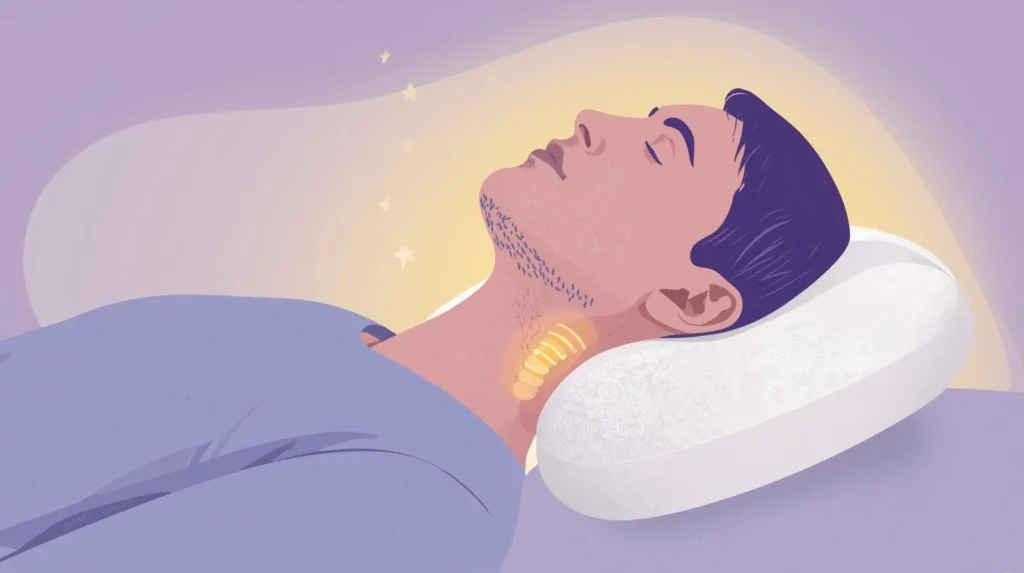
A cervical pillow keeps you more aligned by:
- Filling shoulder gap
- Supporting neck curve
- Keeping spine straight
- Reducing pressure
If it’s properly aligned, shoulder strain would be reduced and the process would be more comfortable.
Back Sleepers: Cervical Pillow Alignment
Back sleepers benefit from pillows that have good neck curve conformance. A contour pillow supports your cervical lordosis and cradles your head.
This prevents:
- Forward head tilt
- Flattened neck curve
- Muscle strain
- Poor posture
Cervical pillows tend to be ideal if you sleep on your back.
Cervical Alignment and Sleep Quality
Poor alignment can disrupt sleep. Pain in the neck can result in restless movements and awakenings.
Proper alignment helps:
- Relax muscles
- Reduce pressure
- Improve breathing
- Enhance sleep quality
Studies indicate that sleeping on an ergonomic pillow increases comfort and wards off neck pain. [8]
Effects of Poor Cervical Alignment During Sleep
Improper alignment can cause:
- Neck stiffness
- Headaches
- Shoulder pain
- Poor posture
- Muscle fatigue
- Reduced sleep quality
It implies increased load on cervical joints and ligaments due to the poor alignment. [9]
In the longer term, that can create chronic pain.
Scientific Findings: Alignment Matters
Research on Cervical Pillow Alignment Importance
According to the survey , cervical contour pillows can also relieve discomfort and cervical position.[1]
Pillow height is another consideration when assessing cervical spine alignment. [6]
Clinical data suggested that orthopedic pillows can effectively relieve pain in the cervical spine and significantly improve sleep. [8]
These studies suggest a sleep posture that maintains cervical lordosis.
Essential Components of Cervical Pillows
Cervical pillows typically include:
- Contoured shape
- Raised neck support
- Head cradle center
- Dual height design
- Firm support material
- Breathable cover
These elements assist in keeping the spinal column in alignment.
Choosing the Right Cervical Pillow
Here are factors to keep in mind when selecting a cervical pillow:
- Sleeping position
- Pillow height
- Firmness
- Material
- Contour design
- Breathability
Choose the right pillow for improved positioning and comfort.
Benefits of Cervical Pillow Alignment
- Maintains natural neck curve
- Improves spinal alignment
- Reduces muscle strain
- Improves sleep quality
- Prevents stiffness
- Supports posture
- Reduces headaches
- Improves relaxation
Alignment is a great indicator of muscle relaxation and pressure relief.
Conclusion
Cervical pillow science is all about maintaining cervical lordosis and spinal neutrality. Pillows for neck support designed to retain the natural curve of the neck and relieve low back strain
Research shows alignment is affected by pillow height, firmness and contour design. An appropriately designed cervical pillow can encourage improved sleep postures and reduce pain.
Aligned sleep is better for your neck health long-term, and can lead to more restorative sleep.
FAQs
Cervical pillow alignment helps to sleep with the natural curve of the neck. An adequately engineered pillow aligns and keeps the head, neck and spine balanced; this reduces strain and pain.
The cervical lordosis is the normal inward bending of the neck that supports head weight. This curve is maintained during sleep which further aids in muscle relaxation, improves posture and stiffness.
However, cervical pillows align the neck so they alleviate tension on the neck. Studies indicate that using an ergonomic contour pillow can help you sleep more comfortably, while also reducing neck pain.
The ideal pillow height aligns your head to the rest of your spine. Pillows for side sleepers are generally taller, akin to your default snooze position, while back sleepers utilize medium-sized contour pillows.
These pillows are also arbitrary and offer structured neck support while retaining cervical curvature/motion. Most pillows focus on being cushy at the cost of ergonomic back alignment.
Yes, rotten neck support translates to all kinds of discomfort twisting and general muscle strain. Cervical posture that maintains the tone of relaxed muscles allows for better sleeping.
References
- Gordon SJ, Grimmer-Somers K. Pillow use: behaviour of cervical spine. https://pubmed.ncbi.nlm.nih.gov/21500076/
- Cleveland Clinic. Sleep posture and neck alignment. https://health.clevelandclinic.org/how-to-sleep-sitting-up/
- Sleep Foundation. Cervical pillow and neck support. https://www.sleepfoundation.org/best-pillows/cervical-pillow
- Mayo Clinic. Neck pain causes. https://www.mayoclinic.org/symptoms/neck-pain
- Erfanian P. Effect of pillow type on neck pain. https://pubmed.ncbi.nlm.nih.gov/12803793/
- McDonnell MK. Pillow height and cervical alignment. https://pubmed.ncbi.nlm.nih.gov/20579905/
- Harvard Health Publishing. Posture and neck pain. https://www.health.harvard.edu/pain/how-to-prevent-neck-pain
- Lavin RA. Cervical pillow effects on sleep quality. https://pubmed.ncbi.nlm.nih.gov/12803793/
- Spine-health. Cervical alignment and pillow support. https://www.spine-health.com/wellness/sleep/cervical-pillows