Bodyweight Exercises:Strength, Building Muscle & Losing Fat
In this article
- What Are Bodyweight Exercises?
- Why Bodyweight Exercises Are Important
- Types of Bodyweight Exercises
- Best Bodyweight Exercises for Beginners
- Bodyweight Exercises for Fat Loss
- Bodyweight Exercises for Strength
- Sample Beginner Bodyweight Workout
- Who Should Do Bodyweight Exercises
- Safe Way to Do Bodyweight Workouts
- Bodyweight Exercises vs Gym Workouts
- FAQs
- Conclusion
- References
Bodyweight workouts are simple yet practical ways of gaining strength, endurance and fitness without the muscle-building equipment. They use your own body to provide resistance, making them adaptable, beginner-friendly and easy to do pretty much anywhere. Mayo Clinic clarifies that body-weight exercises use little or no equipment, while Harvard Health points out that these movements make us more functional as they work multiple muscles and movement at the same time. [1] [2]
Bodyweight training can aid with general fitness, help burn calories, boost balance and build strength in the muscles you use every day. CDC physical activity guidelines also suggest regular muscle-strengthening every week as a part of a healthy routine. [3] [4]
What Are Bodyweight Exercises?
Bodyweight exercises refer to fitness moves where you make use of your own weight in place of dumbbells, machines or other equipment. Muay Thai bands are commonly found in calisthenics, home workouts, warm-up routines and conditioning. According to Harvard Health, body-weight exercise is a form of resistance training that can enhance strength, endurance, flexibility and coordination. [2] [5]
Common examples include:
- Squats
- Push-ups
- Lunges
- Planks
- Glute bridges
- Mountain climbers
Why Bodyweight Exercises Are Important
Build strength without equipment
The advantage of bodyweight exercises is that the resistance provided comes from gravity and leverage, which helps you build your muscle naturally. Strength training can build lean muscle mass, stronger bones and improved calorie burning efficiency, according to the Mayo Clinic. [4]
Improve functional movement
Many bodyweight moves train the body in patterns used every day squatting, pushing, stepping and maintaining a stable position. Body-weight exercise is called functional, as it tends to work multiple muscles and joints at the same time, according to Harvard Health. [2]
Support healthy weight management
Bodyweight workouts can elevate heart rate and boost calorie burning, particularly in circuit or higher-rep formats. According to the Mayo Clinic, strength-training can lead to reductions in body fat as well as making it easier for your body to burn calories. [4]
Strengthen core and posture muscles
A number of bodyweight exercises light up the abdomen, hips, back and pelvis, which are key to stability and posture. Mayo Clinic experts recommend core-strength exercises like bridges and crunches to strengthen the core muscles. [6]
Types of Bodyweight Exercises
Upper Body Bodyweight Exercises
Hit this upper body (chest/shoulders/arms/upper back) circuit.
- Push-ups
- Incline push-ups
- Pike push-ups
- Triceps dips
- Arm circles
These are popular exercises in body-weight strength programs since they’re equipment-free and can be scaled for multiple levels of ability. [1] [2]
Lower Body Bodyweight Exercises
Are the legs, hips and glutes that these exercises target.
- Squats
- Lunges
- Step-ups
- Wall sits
- Glute bridges
Lower body bodyweight exercises can be helpful because they work many large muscle groups and help in balance and mobility. [2] [4]
Core Bodyweight Exercises
Core focused exercises also work on stability, trunk control and good posture.
- Plank
- Side plank
- Dead bug
- Mountain climbers
- Leg raises
According to Mayo Clinic core exercises strengthen the muscles around your abdomen, back and pelvis. [6]
Full-Body Bodyweight Exercises
These exercises engage multiple muscle groups at a time.
- Burpees
- Jump squats
- Bear crawls
- Squat to push-up
- Mountain climbers
Full-body exercises can also be particularly valuable for workouts done at home because they can combine strength and conditioning into a single routine. [2] [5]
Best Bodyweight Exercises for Beginners
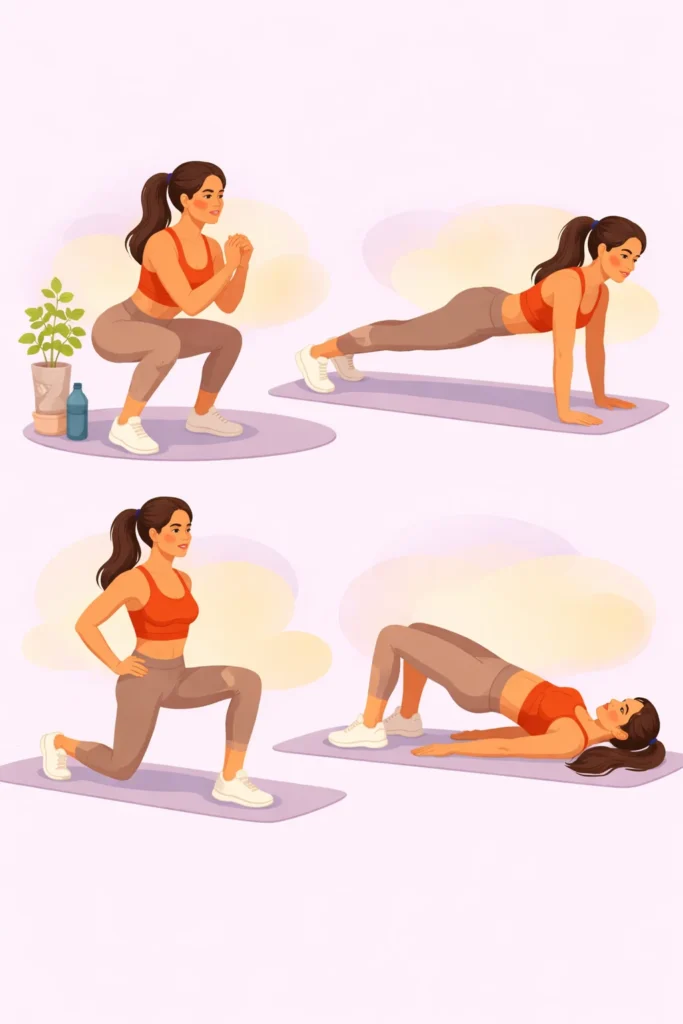
Squats
Squats are a foundational lower-body exercise that works the thighs, hips and glutes while also teaching movement control. They’re simple to change but they are also commonly one of the first drills used in newbie courses. [1] [4]
Push-ups
Push-ups develop pushing strength in the upper body and control through the core. Beginners can perform push-ups against the wall or an incline, before progressing to those on the floor. [1] [2]
Lunges
Lunges build coordination, balance and lower-body strength. They also assist in training each leg independently, which is beneficial for functional movement. [2]
Glute Bridges
Glute bridges apply stress to the hips and core two important areas that are often targeted using beginner- or rehab-based training plans. The Mayo Clinic includes bridges in a list of core-strength exercises. [6]
Plank
The plank is a simple but powerful core hold that builds trunk stability and endurance. [6]
Bodyweight Exercises for Fat Loss
Bodyweight exercises aid fat loss because they keep you more active, burn calories, and build lean muscle. After all, according to the Mayo Clinic, strength training can help decrease body fat and increase lean muscle mass, which complement overall body composition goals. [4]
Good bodyweight movements for this are:
- Jump squats
- Burpees
- Mountain climbers
- High knees
- Skater steps
Circuit-style bodyweight training is particularly effective because it keeps the body moving via short rest periods. According to Harvard Health, body-weight workouts are convenient, versatile and great for targeting your entire body. [5]
Bodyweight Exercises for Strength
Use progressive overload
Ways to make bodyweight exercises harder include doing more repetitions, slowing down the exercise, pausing during it and transitioning to progressively challenging variations. The most effective strength training happens when the muscles are challenged over time. [4]
Try harder exercise versions
Examples include:
Wall push-up → Incline push-up → Floor push-up
Bodyweight squat → Jump squat
Knee plank → Full plank → Side plank
Keep movements controlled
Progressively loading the muscle takes time, and so slow, controlled repetitions help train the tension in the muscles as well as technique, which is vital for safely building strength. [4] [5]
Sample Beginner Bodyweight Workout
Warm-Up
- Arm circles
- March in place
- Bodyweight squats
- Gentle lunges
Main Workout
- Squats for 12 reps
- Push-ups for 8 to 10 reps
- Lunges for 10 each leg
- Glute bridges for 15 reps
- Plank for 20 to 30 seconds
Repeat for 2 to 3 rounds (per fitness level).
Cool Down
- Hamstring stretch
- Quad stretch
- Shoulder stretch
- Deep breathing
It thumps the regular muscle-strengthening exercise should be part of a balanced weekly fitness routine. Adults should do strength-training activity at least 2 days per week, according to CDC guidance. [3]
Who Should Do Bodyweight Exercises
Bodyweight workouts are a fantastic option for:
- Beginners
- People exercising at home
- Students
- Busy professionals
- Travelers
Older adults using modified movements
Those looking for a straightforward, budget-friendly routine
Because these exercises require little or no equipment, they are easily incorporated into daily life. [1] [5]
Safe Way to Do Bodyweight Workouts
Focus on form
Technique matters more than speed. It helps in reducing strain as well as makes the exercise more effective. [4]
Start with simpler versions
Start with the easy variations and then move to more difficult ones. This allows your body to adjust gradually. [5]
Train major muscle groups regularly
As part of a strength program, the Mayo Clinic recommends working the major muscle groups at least two times a week. [4]
Take rest when needed
Giving yourself rest allows your muscles to recover and keeps your workouts sustainable over the long haul. [3] [4]
Bodyweight Exercises vs Gym Workouts
Bodyweight exercises
- No equipment needed
- Easy to do anywhere
- Great for beginners
- Useful for full-body routines
Gym workouts
- Use machines or weights
- Offer more loading options
- Helpful for advanced strength goals
- Usually need a gym setup
While both methods are effective, bodyweight training shines when it comes to convenience and consistency. [2] [4]
FAQs
1.Are bodyweight exercises effective?
Yes, of course bodyweight exercises develop strength, endurance, coordination and flexibility when performed on a regular basis. [2] [4]
2.Can beginners do bodyweight exercises?
Yes, they are great for beginners because you can easily modify them and no equipment is needed. [1] [5]
3.How often a week should I do bodyweight workouts?
A good goal is to also include muscle-strengthening activity on at least two days of the week, in addition to moving regularly throughout each week. [3]
4.Is Fat Loss possible with Bodyweight Workout?
Yes, they can aid in fat loss by boosting activity levels, burning calories and developing lean muscle. [4]
5.What equipment do I need for bodyweight training?
No, the main benefit of bodyweight training is that the resistance is your own body. [1] [2]
6.Can bodyweight workouts build muscle?
Yes, certainly when you add reps and slow down the movement and/or progress to more difficult variations over time. [4] [5]
7.Are bodyweight exercises safe?
They’re generally safe when you use proper form, progress gradually and allow time for rest and recovery. [4] [3]
Conclusion
Bodyweight workouts are an easy, effective and versatile way to get fit at no cost or without even using special gear. They can help build strength, support fat loss and improve posture and develop better control in your everyday movement. Done consistently and with proper form, bodyweight training can become a lifelong part of a healthy regimen. [2] [4] [5]
References
- American College of Sports Medicine. (2022). Resistance Training for Health and Fitness. https://www.acsm.org
- Harvard Health Publishing. (2023). Body-weight exercises for fitness. https://www.health.harvard.edu
- Mayo Clinic. (2023). Strength training: Get stronger, leaner, healthier. https://www.mayoclinic.org
- Cleveland Clinic. (2024). Bodyweight exercises benefits. https://health.clevelandclinic.org
- Centers for Disease Control and Prevention. (2023). Physical Activity Guidelines. https://www.cdc.govayo Clinic. (2023). Exercises to improve your core strength. (Mayo Clinic)


